New England has a lot of great things going for it. We have beautiful landscapes, colorful autumn leaves, and Dunkin’ Donuts.
In the world of heavy metal, however, it can sometimes feel like the good ol’ Northeast gets overshadowed by bigger, more musical regions to the south and/or west.
Godsmack, the heavy-stomping voodoo rockers from Lawrence, MA, have always been an exception to that rule. With their iconic 1998 self-titled debut, the band made an immediate impact on the thriving nu metal and post-grunge scenes and established themselves as an act to watch out for with hits like “Whatever,” “Keep Away,” “Bad Religion,” and “Voodoo.”
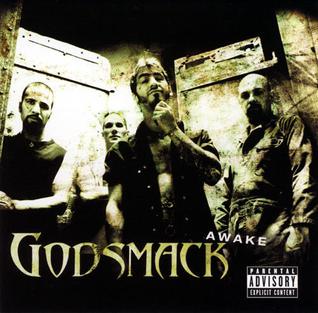
Now, as we exit 2025, the band’s second album Awake has reached a quarter of a century. With a messier, sand-colored album cover featuring a photo of the band, it may not immediately appear as recognizable as the orange and black photo edit of Toni Tiller or the appropriately blank yellow figure depicted for the following Faceless.
Sonically, Awake charges ahead into the new millennium with “Sick of Life,” the opening track that perfectly encapsulates the miserable self-pity that defined so much rock and metal of this time period. This brand of agony isn’t to be confused with the anthemic clean-cutting razor of Papa Roach’s “Last Resort;” here, Godsmack is only interested in connecting fists with the ground in despair.
Despite the band’s New England roots, listeners have always been able to hear influences of traditional and spiritual musics in Godsmack’s sound, defined in pinnacle form on their previous hit “Voodoo.” Awake continues with this, bringing together typical rock instrumentation with more eccentric and exotic sound palettes.
On one hand, in the present day where we are all more aware of the unfortunate impacts that cultural appropriation can have, it would be understandable to squint one’s eyes at how much the Godsmack sound could really be claimed to belong to them. Contemporaries like System of a Down were incorporating traditional music influences from their own home cultures (Armenia, in System’s case) around the same time as Awake’s release. Comparing this album to any similar examples where the influence is easier to trace to its origin, it can raise questions about how Awake has aged over its 25 years of life.
It does seem that frontman Sully Erna’s connection to his Sicilian heritage may easily be understated, so in certain instances of the band’s music, it’s possible that could be a factor. I’m definitely no expert on Sicilian culture and would not claim to be able to discern such influences if I heard them. Perhaps more strikingly, though, I would argue the unique influences the band incorporated into an alternative metal sound that could have easily otherwise blended in with the dime-a-dozen replicas available around Y2K are a huge part of what made them a distinct enough act to have broken through in the first place. In that way, Awake and the rest of Godsmack’s first critical chapter in their discography lies within a catch-22. With the sound palette they maintained, I feel compelled to look at the music sideways. Without it, I’m not sure how many would have turned their heads to look in the first place.
With that said, the lyrics on Awake try to find a meeting point of the world of witches and vampires with the deeply teenaged angst that surely drove many a parent to madness, and largely come up empty. “Trippin’ into a world that never seems too far away,” the title-drop lyric from my least favorite Awake track “Trippin’,” gets stretched so far from the song’s own sense of mysticism that it becomes nonsensical.
I would ultimately consider Awake the least essential of Godsmack’s first three albums, a package I view as comprising the primary range of their contributions to the nu metal/post-grunge genres. Still, the hits that are here, including “Sick of Life” and the title track, leave a sizable footprint in the band’s discography that cannot be ignored.
As the Boston boys look ahead to possible new music in the new year, one can only hope they’ll feel as awake and alive as ever when Erna next endeavors to take out his frustrations on the sandy, wind-torn landscape ahead.

 THE WHITE MOUNTAIN SOUND
Leave a comment